Thawing Frontiers: The Arctic Meltdown That's Rewriting Military Maps
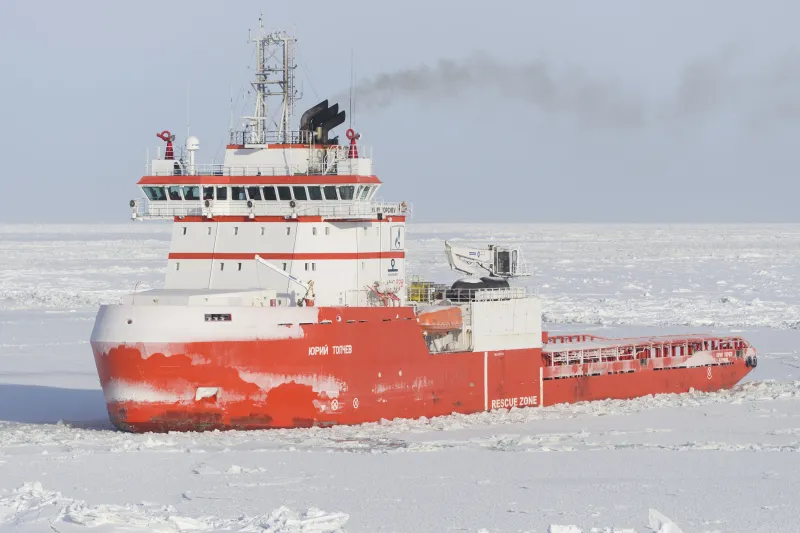
Photo: Tuomas Romu, CC BY-SA 3.0, via Wikimedia Commons
For most of modern history, the Arctic was a wall. Ice made it impenetrable, irrelevant to commerce, and largely ignored by strategists. That wall is now dissolving—and with it, the assumptions that kept the region peaceful.
Satellite records show the Arctic is warming roughly four times faster than the global average. Each summer, the Northern Sea Route along Russia's Siberian coast stays open longer, and shipping traffic reflects it. What was once a frozen dead end is becoming a corridor that cuts thousands of miles off the journey between Asian ports and Northern Europe. For Washington, the uncomfortable question is no longer whether the Arctic matters, but who will write its rules.
Russia's Northern Gamble
No country has moved faster to capitalize. Moscow has reopened Soviet-era bases along its Arctic coastline, stood up a dedicated northern fleet command, and invested in icebreakers at a scale no Western nation can currently match—Russia operates dozens, while the United States fields a handful of aging polar-capable cutters.
Officially, much of this is framed as search-and-rescue and border protection. In practice, it projects control over the Northern Sea Route, which Moscow treats as internal waters, demanding escorts and fees from transit vessels. The United States and its allies dispute that legal claim. It is a disagreement that remains mostly diplomatic—until it doesn't. A detained tanker, a disputed transit, an incident in fog-covered waters: the Arctic offers plenty of ways for a miscalculation to escalate.
Water Without Borders
The Arctic is only the most visible case. Further south, climate stress is straining river systems that hundreds of millions of people depend on.
The Nile flows through eleven countries, and Ethiopia's Grand Renaissance Dam has already brought Cairo and Addis Ababa to the edge of open confrontation over who controls the river's flow. Egypt, almost entirely dependent on the Nile, has repeatedly hinted that water is a matter of national survival. The Mekong tells a similar story: upstream dams in China and Laos have altered seasonal flows so dramatically that downstream deltas in Vietnam and Cambodia are salting over, threatening the rice harvests that feed the region.
These are not abstract disputes. Water scarcity drives migration, migration drives political instability, and instability is where great-power competition finds its opening. Beijing's dam diplomacy along the Mekong gives it quiet leverage over five downstream neighbors. Washington, with no comparable presence, watches from the margins.
The Coming Territorial Free-for-All
Under international law, coastal states can claim seabed resources out to the edge of their continental shelf. As the ice retreats, the prize grows: the US Geological Survey estimates the Arctic holds roughly 13 percent of the world's undiscovered oil and 30 percent of its untapped natural gas.
That has triggered a slow-motion scramble. Russia has planted a flag—literally—on the seabed at the North Pole. Canada and Denmark have spent years filing overlapping claims to the Lomonosov Ridge. The United States, notably, has not even ratified the treaty governing these claims, leaving American companies and negotiators operating on contested legal ground.
What It Means for American Security
The Pentagon has acknowledged the gap. US radar and missile-warning architecture in the far north dates to the Cold War, and the famous 'icebreaker gap' remains unresolved in any serious way. Meanwhile, China has declared itself a 'near-Arctic state' and begun investing in Russian energy projects and polar research—giving Beijing a foothold in a region where it has no coastline at all.
Climate change is often framed as a slow, diffuse threat. Geographically, it is doing something very specific: erasing the barriers that once separated rivals and handing new terrain to whoever prepares first. The melting ice is not waiting for Washington to finish its debate. Neither is anyone else.